
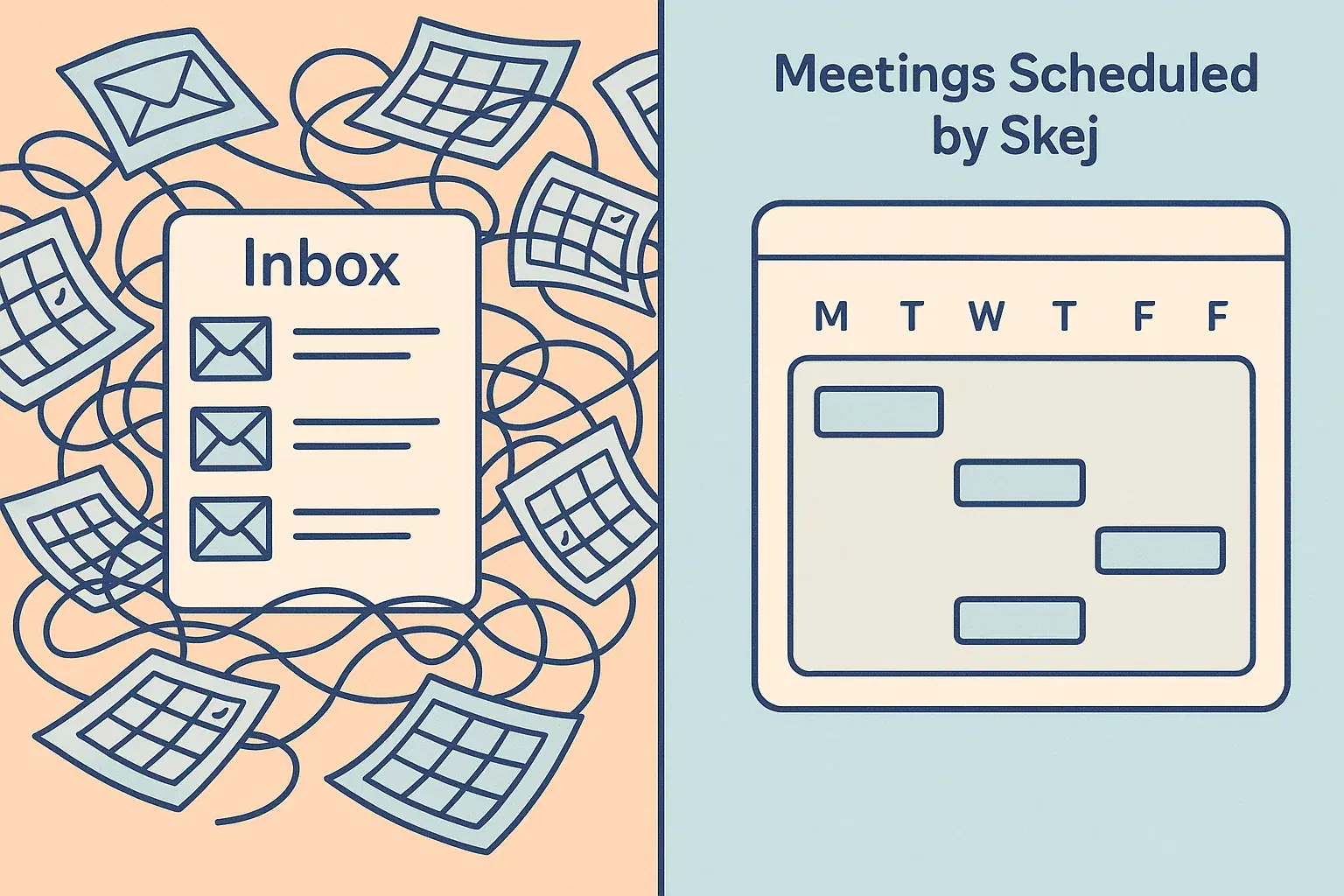
The Best AI Scheduling Assistant for CEOs and Founders
How many hours did you lose this week just trying to set up meetings?
For many CEOs and founders, the answer is more than they’d like to admit. A quick investor check-in turns into a 12-email thread. A global team sync means juggling four time zones. By Friday, your calendar looks less like a plan and more like damage control.
Those hours add up quickly. Time spent coordinating schedules is time not spent on product, strategy, hiring, or fundraising.
That’s where AI scheduling assistants come in. Instead of managing every calendar interaction yourself, these tools handle the logistics — aligning calendars, proposing times, managing reschedules, and keeping meetings moving.
In this guide, we’ll look at the scheduling challenges leaders face, what to look for in an AI scheduling assistant, and why many founders are turning to tools like Skej to take calendar coordination off their plate.
Why CEOs and Founders Need AI Scheduling Assistants
Your calendar should support your work. But for many founders, it ends up controlling it.
Several common issues make scheduling particularly painful at the leadership level.
Decision fatigue from small choices
Leaders are paid to make high-impact decisions. Yet calendars create dozens of tiny decisions every day:
- Should this be 30 minutes or 45?
- Is Monday better than Wednesday?
- Does this work for everyone’s time zone?
Individually these choices are small, but they drain mental energy before you ever get to strategic work.
Constant context switching
Scheduling interrupts focus constantly. You may be deep in product thinking when a meeting request arrives. Then an investor email. Then someone asking if a time still works.
Every interruption resets your focus.
Invisible time leaks
A few minutes confirming a meeting. Ten minutes checking calendars. Another five rescheduling something.
By the end of the week, those small tasks can quietly consume several hours.
Poor boundaries lead to burnout
Without guardrails, calendars expand to fill every open slot. Meetings spill into early mornings, late evenings, and supposed focus blocks.
Founders often lose the very thinking time they need most.
Scheduling mistakes hurt credibility
Double-booking a client, missing an investor call, or replying late to a partner introduction sends the wrong signal. At early-stage companies, perception matters — and sloppy scheduling can undermine trust.
How an AI Scheduling Assistant Helps
An AI scheduling assistant removes much of the friction from managing a busy calendar.
Instead of manually coordinating every meeting, the assistant handles the process automatically.
Removes scheduling guesswork
You set preferences for meeting times, follow-ups, and scheduling rules. The assistant applies those rules automatically whenever meetings are being arranged.
Protects focus time
Rather than interrupting your day to check whether someone replied, the assistant follows up in the background and keeps the conversation moving.
Scales beyond human coordination
Founders often juggle dozens of scheduling threads at once — investor calls, hiring interviews, sales conversations. An AI assistant can manage them all simultaneously.
Responds faster
People expect quick responses when scheduling meetings. An assistant can follow up immediately and consistently without requiring your attention.
Closes small time leaks
Every five minutes saved on scheduling adds up. Automating those tasks frees hours each month.
Maintains professional communication
Scheduling messages remain polite and professional while still keeping conversations moving forward.
What to Look for in an AI Scheduling Assistant
Not all scheduling tools are built for leadership workflows. When evaluating options, several capabilities matter most.
Seamless calendar integration
The assistant should work directly with your existing calendar system — typically Google Calendar or Outlook — without requiring a new workflow.
Intelligent scheduling automation
The best assistants do more than share booking links. They coordinate meetings actively, suggesting times and managing the conversation until the meeting is confirmed.
Flexible follow-up rules
Automated follow-ups help prevent scheduling conversations from stalling. Being able to control the timing and number of follow-ups is important.
Time-zone awareness
For founders working with global teams, the assistant should automatically account for time zones and working hours.
Fast rescheduling
When conflicts arise, the assistant should adapt quickly and propose alternatives without requiring manual coordination.
Strong privacy controls
Scheduling tools access sensitive calendar data, so security and privacy protections are essential.
Skej: An AI Scheduling Assistant Built for Founders
Among modern scheduling tools, Skej is designed specifically to handle the coordination work that typically fills a founder’s calendar.
Instead of relying on static booking links, Skej operates more like a behind-the-scenes assistant. You simply add Skej to scheduling conversations, and it takes care of the rest.
It reads availability across calendars, proposes meeting times, follows up if someone hasn’t responded, and handles rescheduling automatically.
Because Skej works directly within email and messaging conversations, it fits naturally into existing workflows without requiring another app.
For executives managing investor calls, customer meetings, and internal discussions across multiple time zones, that simplicity makes a significant difference.
Why Skej Works Well for Leadership Workflows
Several qualities make Skej particularly useful for CEOs and founders.
Invisible efficiency
Meetings are scheduled and rescheduled automatically without interrupting your day.
Professional communication
Messages sent by Skej maintain a consistent, polished tone with investors, clients, and partners.
Global scheduling support
Cross-time-zone meetings are arranged intelligently, helping avoid late-night or early-morning scheduling conflicts.
Privacy-first architecture
Sensitive conversations with board members, investors, and partners remain secure.
Scales with your role
Whether you're a solo founder or leading a large team, Skej adapts without requiring new processes.
Even saving two hours per week adds up to more than 100 hours per year — time that can be reinvested into strategy, hiring, and growth.
Skej Pricing
Skej is simple to try and easy to scale as your scheduling needs grow.
7-Day Free Trial
New users get full access to Skej with a 7-day free trial. All features are included so you can see how the assistant schedules meetings, follows up automatically, and manages your calendar without restrictions.
Pro Plan — $15/month
The Pro plan is designed for professionals who schedule meetings frequently.
It includes unlimited meetings, automated follow-ups, and multi-channel scheduling across email and messaging platforms. Skej handles the back-and-forth coordination so you can focus on your work instead of your calendar.
Premium Plan — $23/month
Premium adds advanced features for teams and executives who want a more polished experience.
It includes a custom assistant operating from your company’s email domain, along with priority support and additional customization options. It’s ideal for founders, leadership teams, and client-facing organizations that want scheduling to feel seamless and professional.
Final Thoughts
For CEOs and founders, time is the most valuable resource. Yet calendars often consume far more attention than they should.
AI scheduling assistants help solve this by automating the coordination work behind meetings — proposing times, managing follow-ups, and keeping calendars organized.
Tools like Skej don’t just help schedule meetings faster. They remove an entire category of small tasks that quietly drain leadership focus.
And when those tasks disappear, founders gain back something far more valuable: time to lead.
Make scheduling easier with Skej
Skej handles the back-and-forth while you focus on what's important.
Start Scheduling for FreeFree trial · No credit card required