
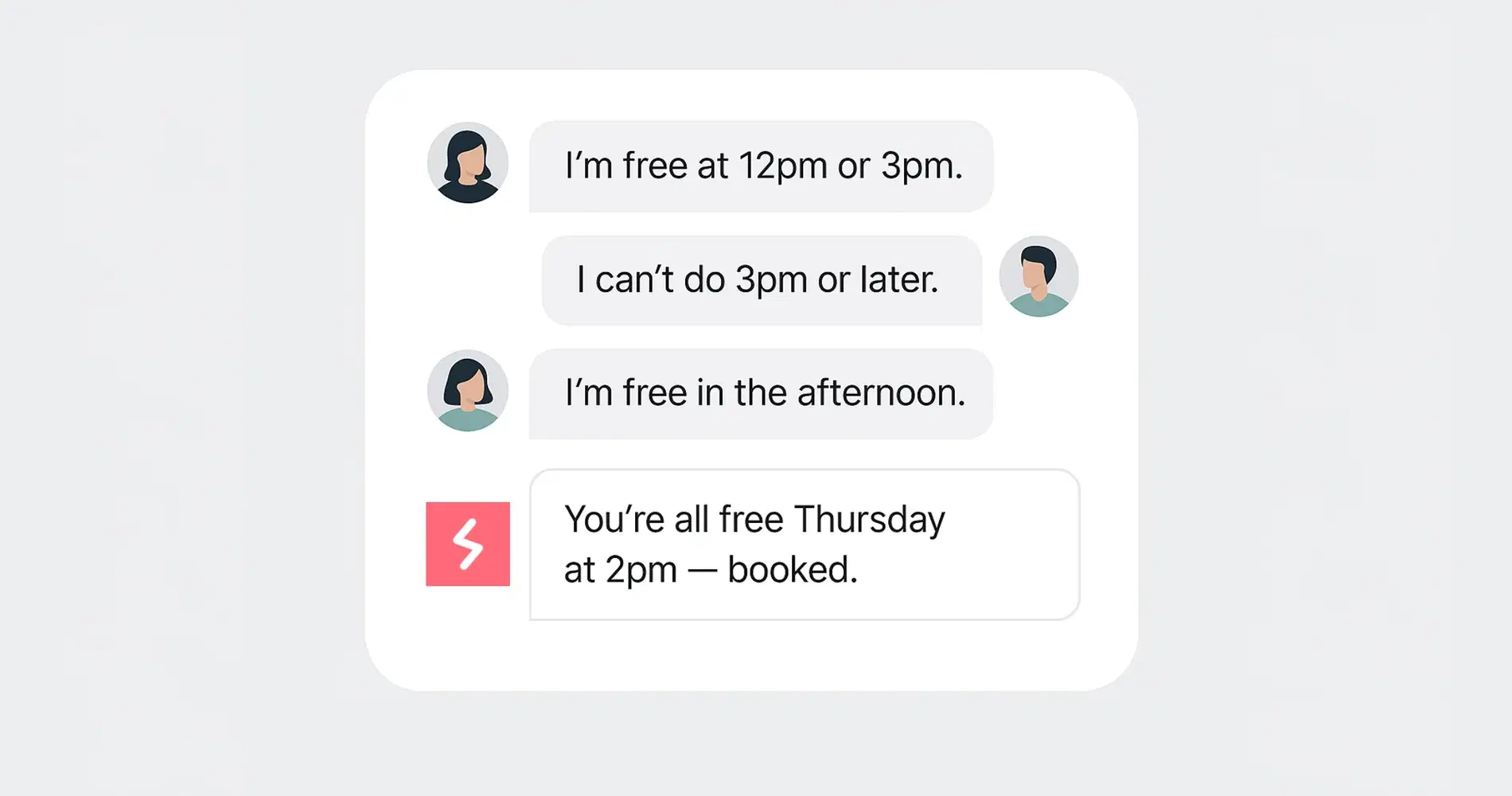
How to Schedule Group Meetings Without the Back-and-Forth
roup meetings are where productivity often goes to die — not in the meeting itself, but in the scheduling.
Trying to find a time that works for three, four, or more busy people can quickly turn into a frustrating process. Endless email replies, conflicting calendars, time zone confusion, and last-minute changes make even a simple 30-minute meeting hard to coordinate.
If you're the person responsible for organizing the meeting, it can feel like you're suddenly a part-time scheduling assistant.
This is why many teams now use group meeting scheduling tools to automate the process.
Why Scheduling Group Meetings Is So Difficult
Scheduling a one-on-one meeting is fairly simple. But once multiple people are involved, complexity grows quickly.
Imagine you're trying to coordinate a meeting between:
- you
- a cofounder
- your head of marketing
- a partner from another company
Everyone has different calendars, different tools, and different availability.
The typical process often looks like this:
- You start an email thread asking for availability.
- People reply with different times that work for them.
- Some of those times conflict with others.
- You try to find overlapping windows manually.
- Someone's schedule changes and the process starts again.
Instead of focusing on the meeting itself, you spend time coordinating calendars.
What Group Meeting Scheduling Software Does
Group scheduling tools are designed to solve this problem by automatically finding meeting times that work for multiple participants.
These tools can:
- check availability across several calendars
- account for time zones
- propose times that work for everyone
- automatically confirm the meeting once a time is selected
- send calendar invites and reminders
By automating these steps, teams can schedule meetings much faster and avoid the typical back-and-forth.
How Skej Automates Group Meeting Scheduling
Skej approaches group scheduling a little differently.
Instead of asking participants to vote in polls or choose from booking links, Skej works directly inside email conversations.
When you CC Skej on an email thread, it can:
- read the context of the conversation
- check your calendar availability
- coordinate with other Skej users’ calendars
- propose meeting times that work for everyone
- confirm the meeting automatically once a match is found
All of this happens inside the existing email thread.
Why Skej Works Especially Well for Team Scheduling
Group meetings become even easier when multiple participants use Skej.
If only one person uses Skej, it can still coordinate scheduling based on replies.
If several participants use Skej, it can check everyone’s calendars and find overlapping availability instantly.
And when everyone on the thread uses Skej, meetings can be booked automatically as soon as a matching time appears.
Instead of manually coordinating availability, Skej acts like a shared assistant that already knows everyone's schedule.
When Group Scheduling Tools Are Most Useful
Automated scheduling is particularly helpful for meetings that involve several participants or cross-team coordination.
Common examples include:
- leadership team syncs
- client meetings
- board meetings
- recruiting interviews
- project check-ins
- cross-functional planning sessions
Any time multiple calendars need to align, automation can save significant time.
A Faster Way to Schedule Group Meetings
For teams that regularly coordinate meetings across multiple people, manual scheduling can quickly become a hidden productivity drain.
Tools like Skej help remove that friction by automating the process and coordinating availability directly within conversations.
Instead of juggling calendars or chasing replies, you can simply include Skej in the email thread and let it handle the coordination.
Make scheduling easier with Skej
Skej handles the back-and-forth while you focus on what's important.
Start Scheduling for FreeFree trial · No credit card required