Scheduling Isn’t Just a Convenience Layer Anymore
Most people think of scheduling as a simple utility.
Find a time. Send a link. Book a meeting.
But that framing breaks down quickly inside an enterprise.
Because the moment a system can:
- send emails on behalf of employees
- access and interpret calendar data
- coordinate across internal and external stakeholders
- and take action autonomously
…it’s no longer just a scheduling tool.
It’s operating inside a sensitive, high-trust surface area of the business.
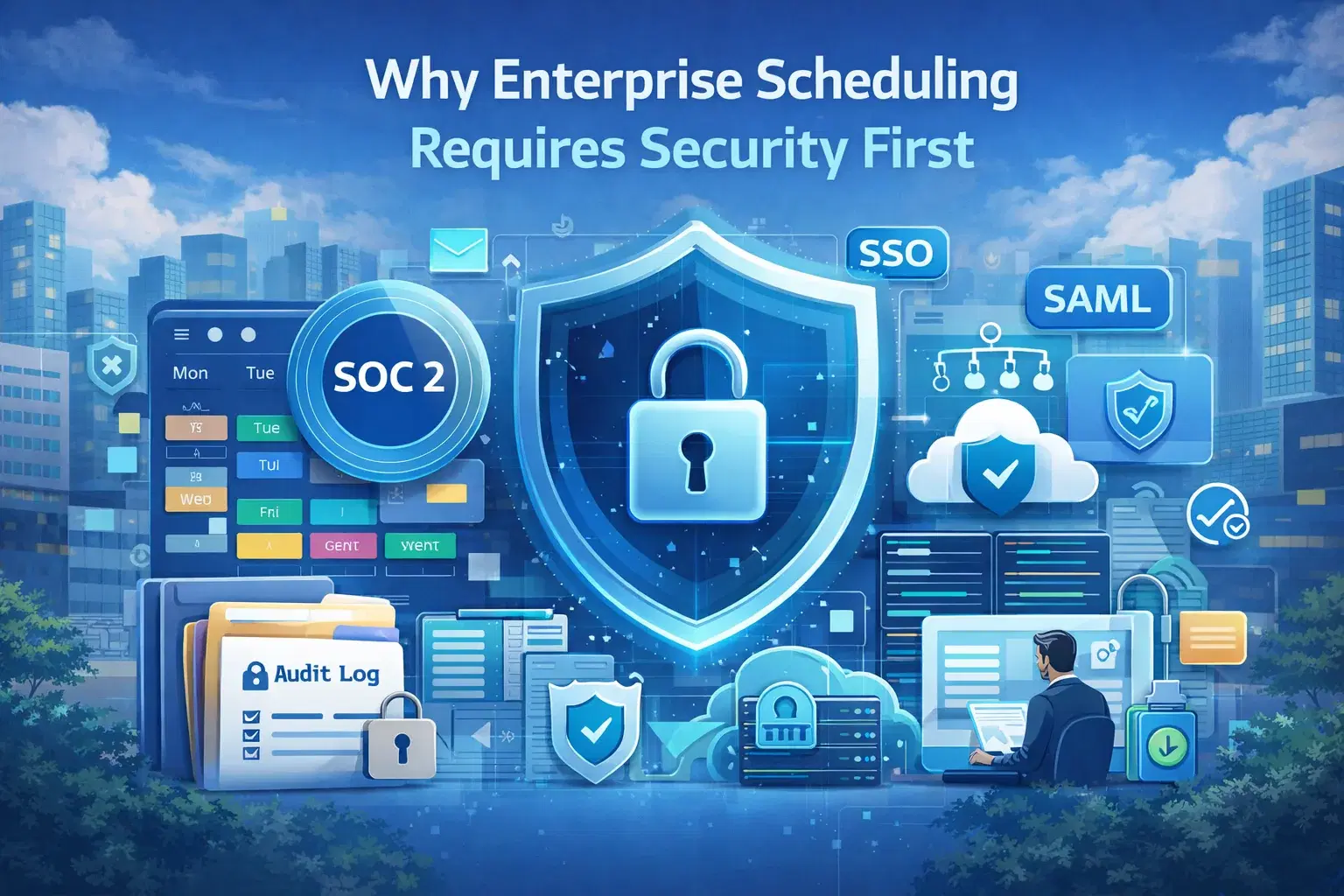
Scheduling Is Already a Security Surface
Calendars aren’t just time slots — they’re context.
They contain:
- executive meetings
- customer conversations
- hiring pipelines
- deal flow
- internal strategy discussions
Now layer in automation.
If a system is reading that data, making decisions, and sending messages externally, it’s effectively acting as an extension of your team.
And at that point, a scheduling mistake isn’t just inconvenient.
It can mean:
- the wrong people included on a thread
- sensitive context exposed externally
- incorrect or misleading communication sent on behalf of an employee
- breakdowns in coordination with customers or partners
This is where scheduling crosses into security and trust, not just productivity.
Most Scheduling Tools Weren’t Built for This
Traditional scheduling tools were designed as utilities:
- static booking links
- manual availability selection
- limited system access
They weren’t built to:
- interpret context
- make decisions
- or act autonomously across communication channels
But AI is changing that.
As soon as you introduce an assistant that can actually execute, the risk profile changes completely.
You’re no longer evaluating a tool.
You’re evaluating a system that can operate on your behalf.
Why AI Makes This More Complex — Not Less
AI-powered scheduling sounds simple on the surface:
“Just let an assistant handle it.”
But in practice, this introduces new challenges:
- Unbounded behavior → What can the system actually do?
- Decision ambiguity → How does it choose between multiple valid options?
- Execution risk → What happens before something is sent or scheduled?
- Data exposure → What context is being used, and where does it go?
Without clear constraints, validation, and controls, these systems can behave unpredictably.
And unpredictability is exactly what enterprise environments cannot tolerate.
Skej Was Built for This Reality
Skej isn’t just generating suggestions.
It’s taking action — sending messages, coordinating schedules, and managing workflows on behalf of users.
That changes the bar entirely.
From day one, we’ve treated scheduling as a security-sensitive system, not a lightweight utility.
That means:
- Constrained behavior
- The system operates within clearly defined scheduling workflows
- No unpredictable actions
- Validation before execution
- System-level checks before messages are sent or meetings are scheduled
- Strict data boundaries
- Only the data required for scheduling is accessed and used
- No human-in-the-loop exposure
- Scheduling is fully automated without introducing additional access to user data
- Enterprise-ready controls
- Built to align with how organizations think about access, auditability, and risk
This isn’t about adding security later.
It’s about building with the assumption that this system is operating inside critical business workflows from day one.
The Category Is Shifting — Fast
We’re moving from:
• tools that assist
→ to systems that act
And that shift comes with real implications.
The more autonomy you give software, the more important it becomes to define:
- what it can do
- what it can’t do
- and how it behaves under uncertainty
Scheduling might look simple on the surface.
But at scale — and especially with AI — it becomes a high-trust, high-impact system.
Final Thought
If your scheduling tool can:
- read your calendar
- communicate with external parties
- and take action on your behalf
…it’s already part of your security surface.
The question isn’t whether security matters.
It’s whether the system was built with that assumption from the start.
Make scheduling easier with Skej
Skej handles the back-and-forth while you focus on what's important.
Start Scheduling for FreeFree trial · No credit card required